




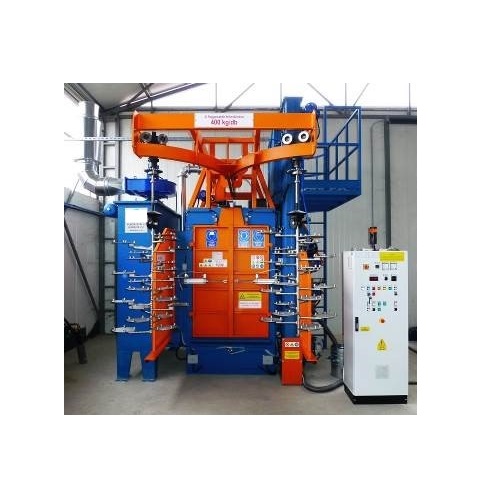
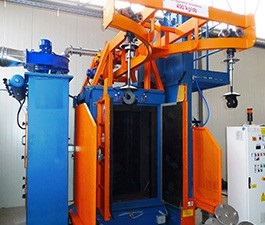
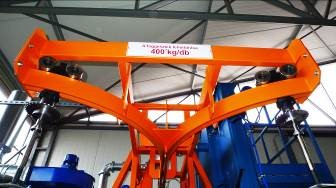
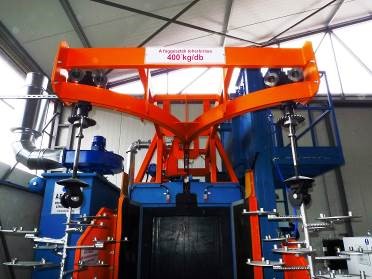
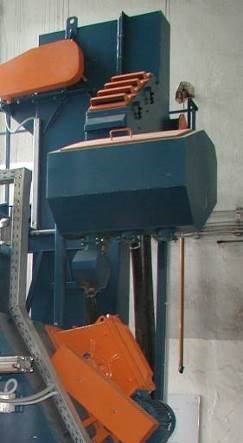
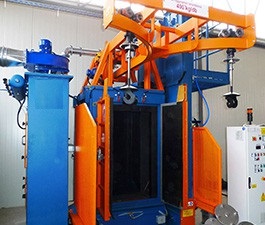
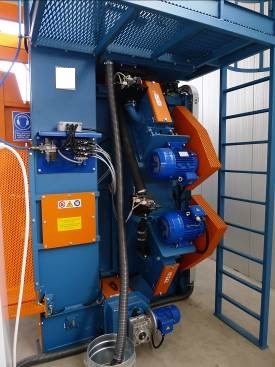
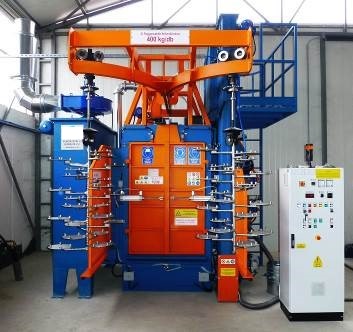
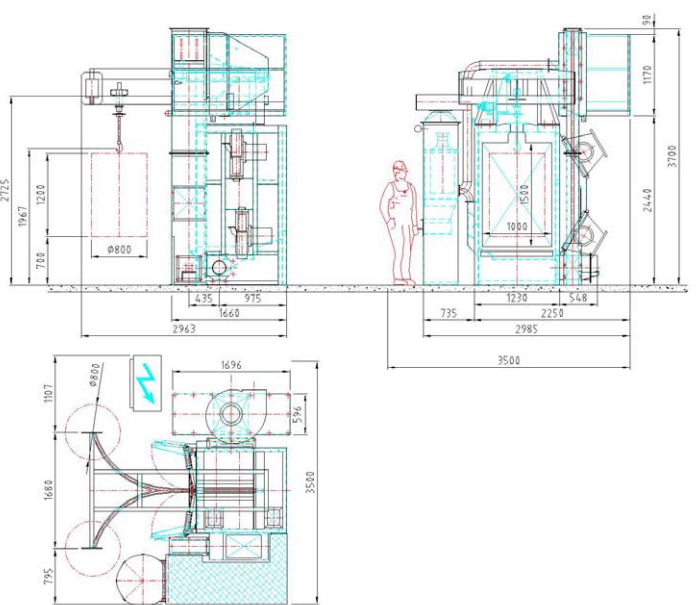
Y-type suspended 3-wheel shot blasting machine for external cleaning of gas cylinders. Gas cylinder length -1200 mm, diameter - 800 mm, weight -400 kg. Machine capable of 6-12 hangings per hour (approx. 250 gas cylinders per shift). 180 kg grains/min. One suspension for up to several gas cylinders
Durable structural design and standard solutions for safe operation.
Tailored to individual technical requirements, gas types and operating conditions.
Gas cylinder length -1200 mm, diameter - 800 mm, weight -400 kg. 2 wheel sprayer for cleaning gas cylinders. 1000 kg of particle charge. Depending on the size of the gas cylinders, one suspension can be up to several gas cylinders. Machine capable of 6-12 hangings per hour (250 gas cylinders per shift).
The HC tip. is generally recommended for the surface cleaning of small castings, welded, forged workpieces, and parts that can be suspended in bundles. The equipment has two nozzles.
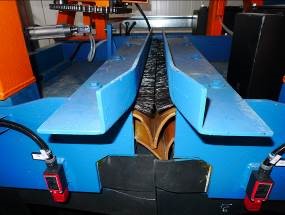
Their offset planar arrangement ensures that the cleaning effect of the grit jet is applied to the entire surface of the workpiece. The nozzles are 6-blade designs with axial gravity feed, mechanical pre-accelerator and precise nozzle jet adjustment. The parts to be sprayed are to be drawn into the cleaning chamber on a manual conveyor track suspension. The suspension moves continuously in rotation with the workpieces, in front of the spreader wheels. The two hangers mounted on the Ipsilon track allow one hanger to be in the spray booth while the other hanger is preparing the next batch to be sprayed. The inner surface of the spray booth, which is located in the active particle beam zone, has a high wear-resistant manganese steel coating, while the other inner surfaces are protected by a wear-resistant rubber sheet.
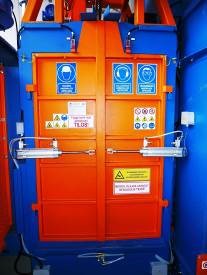
Grain spraying is only possible with the cabin doors closed, which provides perfect protection against grain bounce. The doors of the cabin are opened and closed by a pneumatic cylinder. Closed and continuous circulation of the spray material is ensured by a conveyor belt, a serrated elevator, a spray material cleaning unit and a dosing unit. For optimum surface cleanliness, the quantity of spray material discharged and the spraying time are infinitely adjustable. As an option, the nozzle speed can be controlled by a frequency converter. The cleaned parts shall be removed from the chamber by hand after spraying is completed and the door opened, and replaced by hanging new parts prepared in the meantime. The dust generated during the grit blasting process is extracted and separated by a modern cartridge dust extractor-dust separator. The equipment can be operated from a central control cabinet.
Manual mode for service purposes, automatic mode for normal use.
Dust extraction, dust separation
To remove dust from the working area and prevent it from escaping into the environment. Elements of a dust extraction system:
The exhaust air can be recirculated back into the working space or exhausted to the outside. Dust content of the cleaned air after the dust collector: max 3 mg/m3.
V-belts and chain drives are covered to ensure inaccessibility. The doors on the machine body are electrically interlocked to prevent the machine being started with the door open and to stop the machine immediately if the door is opened. The electrical equipment on the control cabinet is secured against unauthorised operation by locks. The spreading process cannot be started without dust extraction. There are 2 emergency stop buttons on the equipment, pressing any one of which will stop the equipment immediately. All units of the equipment are connected to the wired contact protection system. The power cables are routed to the motors in a sealed conduit. The electrical units of the equipment are provided with the necessary standard markings
The noise level of the grit spreading equipment. The noise generated by the machine is expected to be 79-83 db(A) measured in the immediate vicinity of the machine. The noise emitted by the dust extraction and separation unit is 75 and 78 db(A) respectively. Noise levels higher than these values are expected when the cartridge cleaning valves are operated - the impulse noise level is around 80 db(A).
Environmental exposure to dust As described in the proposal, the airborne particulate matter after the dust filter is below 3 mg/m3. This is confirmed by the measurements carried out so far. The total amount of filtered air can be discharged to the environment or returned to the working area. The spray material used for spraying on the equipment will be steel grit. Therefore, the airborne dust pollutant will not contain fibrogenic substances, in the absence of which the permissible average concentration will be 10 mg/m3 according to clause 2 of the relevant standard „Air quality requirements for workplaces - Respirable dusts” - MSZ-21461-2:1992.
A fire classification of equipment The spray room and the machinery are classified as fire hazard class „D”. The filter unit is not classified as such. According to the relevant regulation, the outer surface and the 1,000mm perimeter of the filter unit are classified in zone 22 according to EN 1127-1.
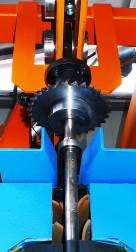
Engine room (spreading space) The machine housing is a welded plate construction with profile steel reinforcement. The inner surface has manganese steel wear protection. The machine housing is fitted with 2 ABR tip nozzles in an offset plane on the side walls. Each nozzle is driven by a 5,5kW 2600 rpm electric motor with four V-belts. Belt tensioning is achieved by tilting the motor bracket. The bottom of the machine housing has a conical trough design. This is where the fallen grit and heavier dirt is collected. In the conical trough is a conveyor pulley which transports the spray material to the serrated elevator. The suspension rotary drive is also located on top of the machine housing. To extract the dust generated in the machine housing, a dust extraction nozzle is provided on the machine housing, through which the machine housing is connected to the dust extraction network of the complete machine.
Manganese wear protection The inside surface of the spreading chamber (machine housing) in the spreading plane is covered with a special wear-resistant manganese plate. The sides and ends outside the spreading plane and the doors are covered with wear-resistant rubber sheeting. The thickness of the plate is 5-8 mm. The wear protection protects the structural parts of the machine from the damaging abrasive effects of the spray jet for a long time. The characteristic property of the manganese steel 13% is that the surface becomes harder and harder due to the impact abrasion of the grain (Hadfield steel). The manganese steel is welded with special electrodes which have abrasion protection properties corresponding to the material.
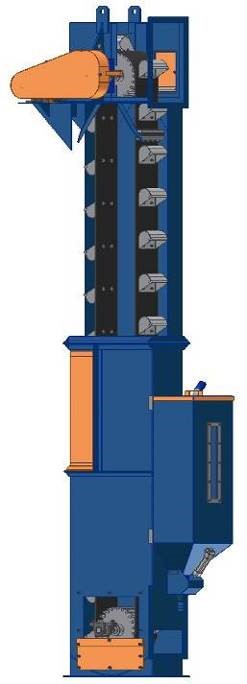
Serious elevator. Main parts: lower stem element, upper stem element and head. The lower wing element includes the lower drum of the elevator, with the bearing arrangement. The lower wing element is a welded construction of edge-bent plate, with connecting frames on the sides to connect the cross conveyor pulley. The upper wing element is a simple rectangular self-supporting structure. It contains the mounting hole for the strap mounting. The head consists of a drum, a chain tensioning device and a release opening to drive the serpentine elevator. The head is connected to the upper arm by a bolted connection. The drive drum in the head drives the serpentine belt, which is also used to tension the belt. The geared motor drives the drum by chain drive. The cups are attached to an endless fabric-inserted rubber belt by means of a screw connection. Transport capacity: 6 m3/h, Drive power: 1,5 kW
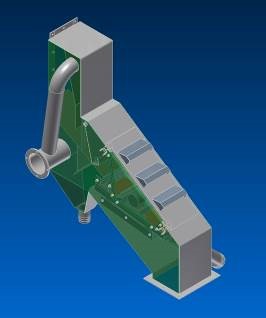
Spray Cleaner A fine plate welded, suction system two-stage spray material separator. The surface of the steps is rubber-coated. Suction openings are provided on the door. The rear end of the wind spreader is fitted with a pipe stub. A butterfly valve controlling the air velocity can be connected to either end of this. The dust particles separated by the blower are discharged through a rubber tube into the dust tank. The cleaned particles slip into the feed-buffer tank.
Spray agent dosing tank The spray material is separated in the spray material cleaner and collects in the feed hopper. A sector lock at the bottom of the dosing hopper ensures control of the spray nozzle grain supply. The sector lock is pneumatically operated. By adjusting the baffles, the quantity of grit to be dispensed can be set. The spray material in the hopper can only flow through an internal sieve, which traps large particles that can cause disturbances in the spray heads. Tank volume 0,3m3- Number of drain holes: 2. From the drain stubs, the spray material flows through wear-resistant rubber hoses to the spray turbines.
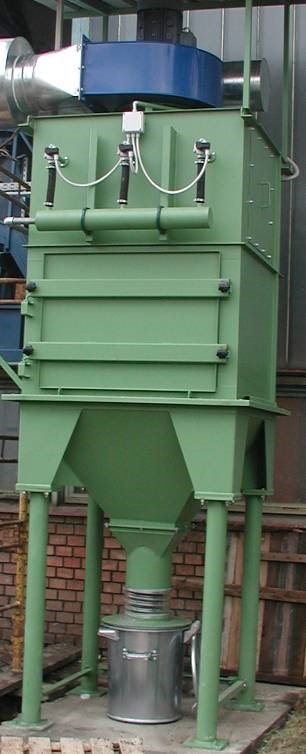
Dust extraction system. Includes- 1 pc. APSZ 4 tip cartridge automatic compressed air pulse back cleaning filter unit, complete with controls, cartridges, pipe fittings, dust collection hopper, feet 1 dust collection vessel. Exhaust fan with drive motor. Air ducting with the necessary air handling components, nozzles, silencer, fasteners.
On-site installation, commissioning. The mechanical units delivered are assembled on site (domestically) by our specialists. The assembled grit spreading machine will be commissioned, and the Customer's designated personnel will be trained in its operation and maintenance.
Purpose of the equipment Used to filter dusty air generated in industrial plants and equipment. Fully automatic, it is a long-lasting device, capable of separating a wide range of dusts with excellent efficiency.
How the equipment works The filtering air ( gas ) flows into the air chamber through the porous air vent. It passes through the filter cartridges , from the outside inwards, while the dust is deposited on the outer surface of the cartridges. The cleaned air is discharged through the outlet nozzle, the separated dust falls into a hopper from where it leaves the filter through the outlet fitting. The cartridges are cleaned by pulsed injection of compressed air. The injection time and the pause time can be varied by means of an electronic control unit.
Structural description The equipment is built according to the cabinet principle. The filter elements and parts of the frame and the control are the same for different sizes of dust filters. The air to be cleaned enters the machine through a hose on the side of the machine. The air flows through the cartridges into the outlet chamber and exits through the exhaust cover. The air can only enter the outlet chamber through the filter cartridges, which have a special rear wall to ensure a stable and dust-free grip on the cartridges. The filter cartridges are secured by screws. The outlet chamber contains the nozzles for cleaning the cartridges. These are positioned so that the high pressure air flowing out of the holes can enter the cartridges and blow the accumulated dust off the surface of the filter cartridges from the inside out. Air enters the nozzles from the air reservoir through a diaphragm valve. The diaphragm valve is controlled by an electronic control unit. The blow-off and pause times can also be adjusted within given limits. For changing the filter cartridges, large sealed doors are fitted to the outlet chamber so that maintenance can be carried out safely and professionally. Dust falling due to gravity and blow-down falls into a conical hopper below the chambers, from where it is discharged through a dust collector into the dust collection vessel. The quality of the cartridges installed in the equipment and the measurements carried out so far ensure that the dust content of the air emitted is 3 mg/m3 which air can already be recycled to the suctioned space. The inlet and outlet chambers of the machine are made of sheet steel, with a seal between the elements to ensure that they are not spraying. The machine is bolted to a profiled steel frame and can be fixed in position via the frame elements. The equipment requires no maintenance.
Air ducting The air ducting consists of galvanized straight pipes and pipe nozzles, pipe couplings. It connects the suction and discharge points of the grit spreader, dust collector and exhaust fan.
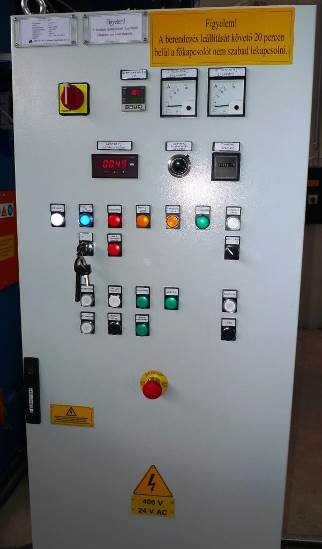
Control All electrical equipment can be started and stopped from the control cabinet. Here you will find the main switch for energising and de-energising the equipment. The control ensures that the various motors are automatically started and stopped in the correct sequence. It provides overload protection for the motors and safety interlocks. Electrical supply requirements of the equipment: 3 x 400 V, 50 Hz , control voltage 110 V AC.
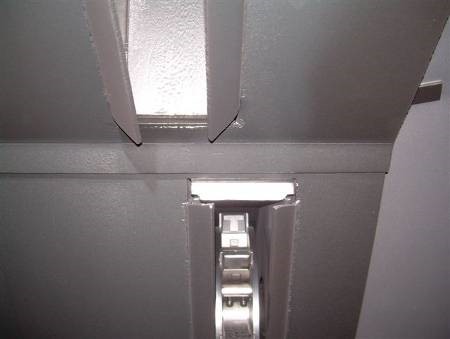
Convejor track The suspension, loaded with the workpieces to be granulated, is conveyed to the spreading area and to the loading and unloading position via a conveyor track connected to the top of the machine. The conveyer track is made of I-beams of a size corresponding to the load capacity of the suspension. The track is generally in the shape of a „Y”, but may be in the shape of a „T” or half „Y” if local conditions require. The track is fitted with two suspension trolleys. The suspensions are moved by hand.
Maximum dimensions of the suspension:
Dimensions of the grit distributor and tspace requirements for ponding: according to the attached drawing
Scattering mode: with spreader wheel, manual and automatic mode
Service staff needed: 1 person
Spreading material: Steel grit GP type
Spreading charge: 400 kg
Spreading power: 6-12 suspensions per hour
The noise impact of the machine on the environment: 79-83 dB(A)
Spreading heads
Number: 2 pieces
Type: ABR-380
Diameter: 380 mm
Impeller speed: 2600 rpm
Eye spray: 90 kg/min/spray head
Drive power: 5.5 kW/spray head
Conveyor belt
Load capacity: 400 kg/hanging
Energy demand
Electric: 16,5 kW
Compressed air
Pressure: 6 bar
Volume: 6 m3/hour
Dust extractor fan power: 3500 m3/h
Electrical data
Supply voltage: 3 x 400 V
Control voltage: 24 V
Frequency: 50 Hz
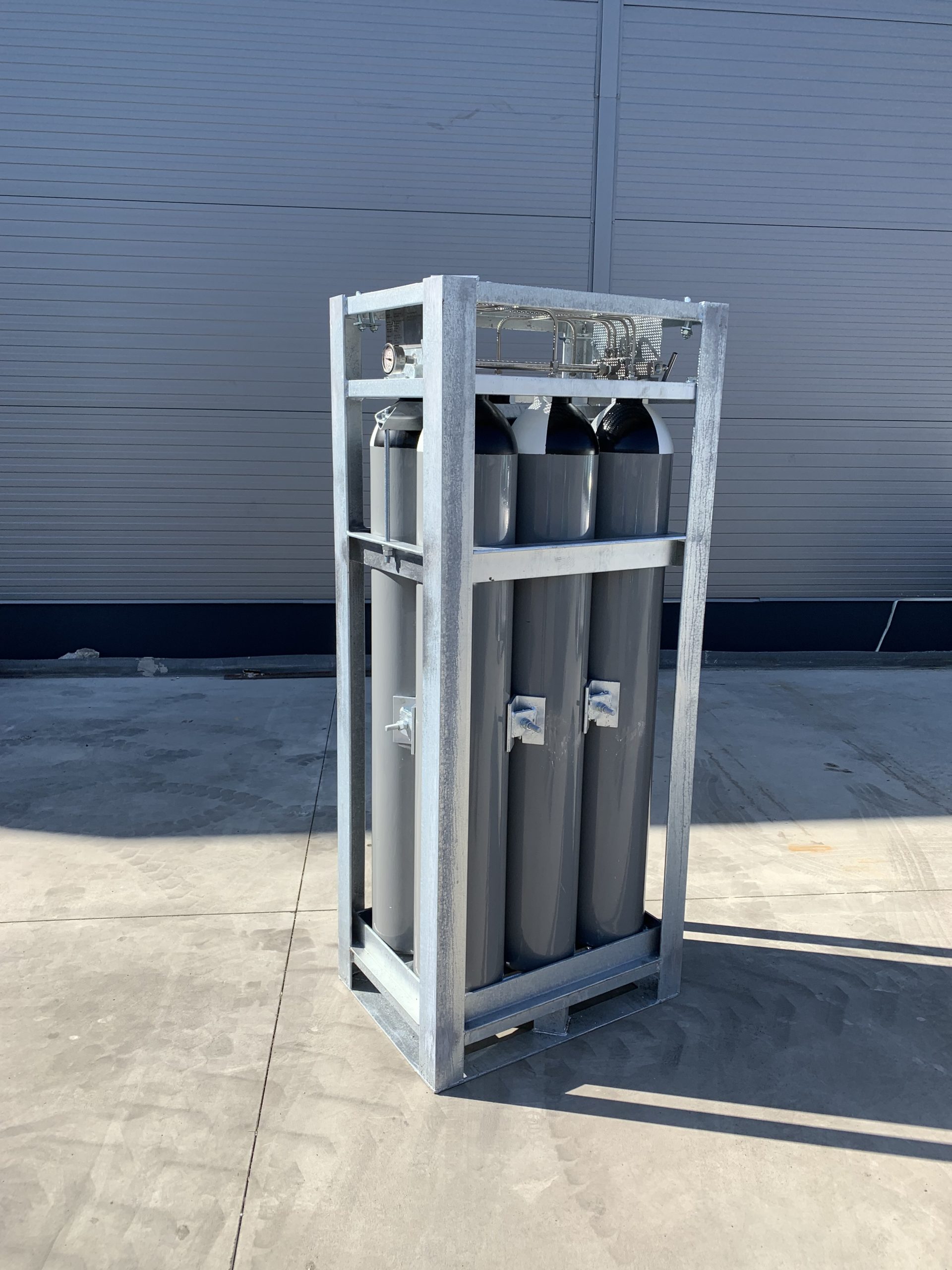
6 x 50 litre gas cylinder bundle for 200 bar, 300 bar or 350 bar operating pressure, for permanent or liquefied gases. Our gas cylinder bundles are manufactured in accordance with EU standards. Welded galvanised structure with stainless steel manifold piping, and many other benefits. Please click for details. For bespoke design and execution, and for volume discounts, please call.
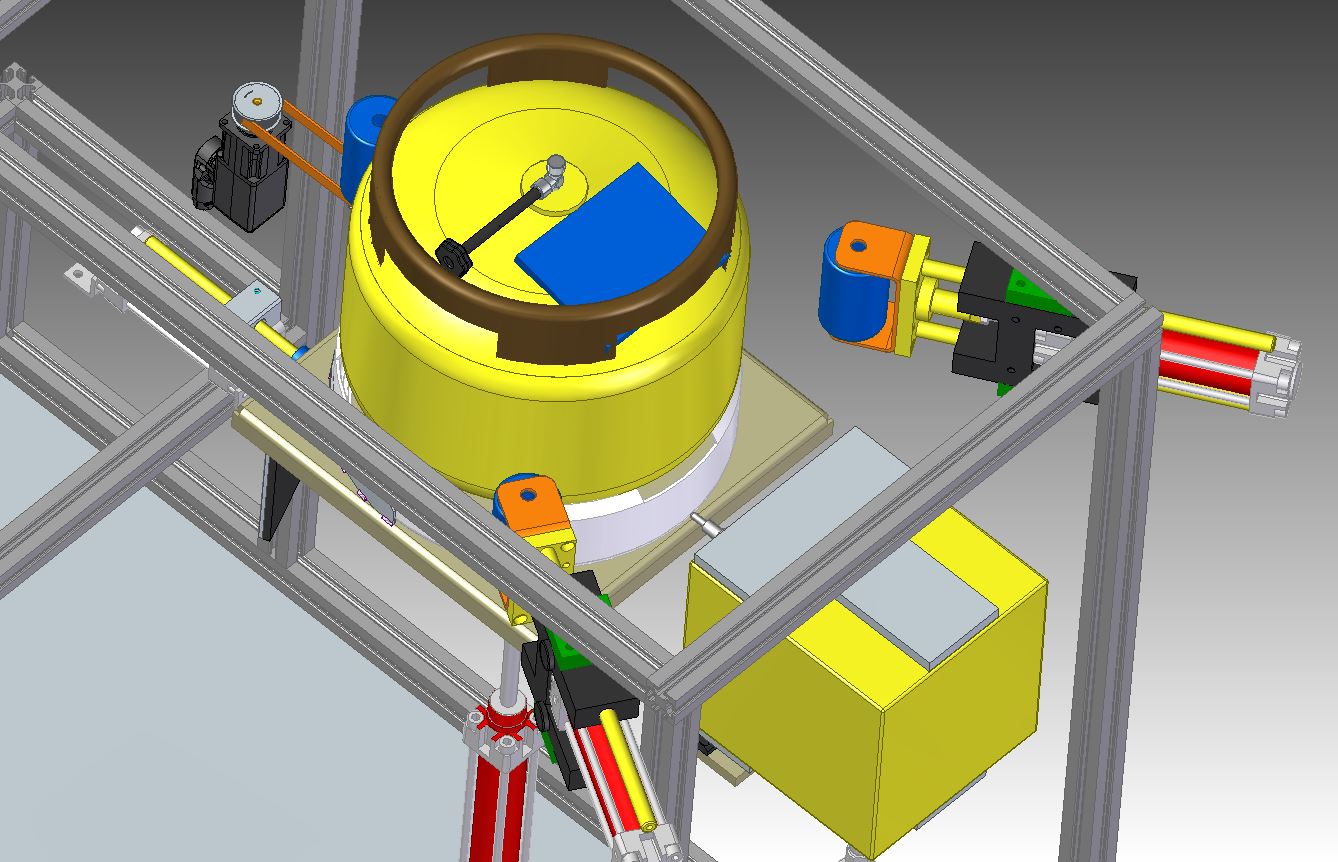
Bespoke labelling and engraving, stamping machine design and manufacture. Whether you have a special bottle size or a special product, we can meet your needs.
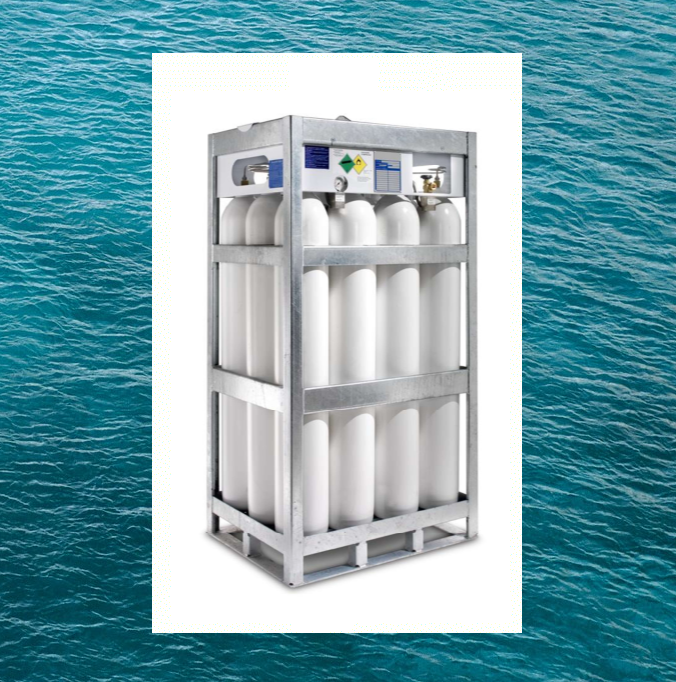
Vertical gas cylinder bundles for marine use. Special fixing lugs, marine-grade surface treatment, approvals for marine and harbour use. Available in 4, 8, 9, 12, 16, 20, 24, 30 cylinder configurations, with operating pressures of either 200 bar or 300 bar. Robot-welded, hot-dip galvanised steel construction. For a bespoke construction and quantity discount, please call us.