




Gas cylinder maintenance process
My article series aims to introduce LEAN technologies and promote the LEAN approach in the field of gas cylinder maintenance.

Mi a LEAN?
The simplest definition of LEAN is the elimination of waste. It is about achieving a given goal, result, and quality with the least possible resources. LEAN always puts the customer at the centre. The customer must define what they consider value, what they are willing to pay for, and how much.

Is the market research scene familiar to everyone?
Is this new product good?
– Yes
Fantastic
Excellent...
And would you actually use it?
– Of course
– Of course
...and then: but how much is he prepared to pay for it?
– Er, er, er
– I still need to think about it
– That’s enough
– 0 EUR
After this, the question we can always ask ourselves is: Have we created value or not?
„The Lean approach should begin by consciously defining value, specifically with regard to a product offered at a certain price with particular characteristics, through dialogue with the customer.”Taiichi Ohno
What is the product?
Our article series focuses on gas cylinder maintenance services.
The core product: security
Maintenance carried out and documented in accordance with the relevant standards, resulting in the customer's gas cylinder being safely kept in operation and refilled for the longest possible period.
The main players in this sector are the industrial gas companies. In our region, in no particular order, but alphabetically listed: Air Liquide, Air Products, Istrabenz, Linde, Messer, Praxair, SAPIO, SIAD, SOL.
The partners' main product is not the gas cylinder. They want to sell or use gas. The gas cylinder is just a necessary evil. If they didn't need gas cylinders as packaging, they wouldn't buy them.
The gas cylinder rental fee paid by gas buyers, despite being a significant cost on their bills, represents only a fraction of the gas manufacturers' revenue. If they were able to sell gas without cylinders, I would likely be writing about my hobby, beekeeping, right here and now, and PWENT Kft. would not be selling gas cylinder maintenance machines.
„If the customer wants it, I'll even shoot the moon out of the plug!”András Lajsz, World Champion Mixologist
It's a bit extreme, but translated to the gas industry, I usually say it like this: if the customer wants to paint little pink flowers on the bottle, then that needs to be priced in.
Aesthetics
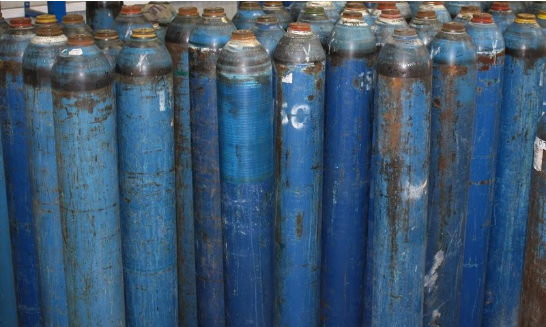
The gas cylinder can just about meet the necessary minimum. It may be unsightly, but if there are no safety objections, it can be refilled and used.
From an aesthetic perspective, the minimum requirement today is that a gas cylinder can be identified by its colour. This can be more or less paint on the neck or body of the cylinder, but it can also be a durable powder coating that is resistant to UV radiation, corrosion, and physical damage.
There might be an almost invisible inscription under the paint layer, or a clearly legible embossed marking made with dot engraving, which offers great security to the filling personnel. There might be a rusty neck, a rusty cap, or it might indicate cleaned, refurbished parts.
The market will become increasingly stronger. Customer needs cannot be ignored. While in the field of medical gases, taking GMP regulations into account, aesthetic requirements are stringent, there are lower expectations in other areas.
If we want to ensure that we are selling good quality and durability to our customers, then I recommend that everyone works with at least a few diving customers. In my experience, divers have an almost personal relationship with their tanks. If our service is problematic anywhere, it will become apparent within moments.
Clarity
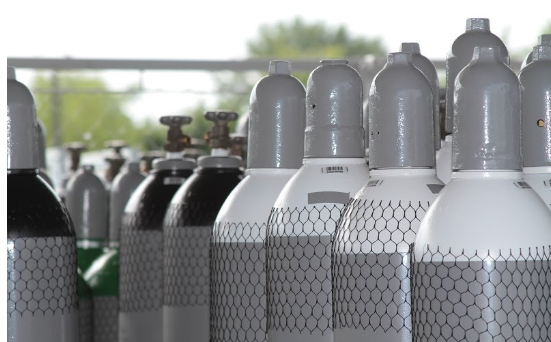
We can talk about both external and internal cleanliness. External cleanliness can be handled with manual wire brush cleaning and roller-applied manual surface protection, or even with a closed conveyor belt cleaning-painting system, with shot blasting and powder coating on the entire surface.
In the first case, we can expect residual paints and corrosion after surface preparation. The treatment of the sole and sole ring, i.e. the area most exposed to the risk of corrosion, requires considerable manual work with special attention.
Often the pad inverter part is used here, thereby reducing the capacity of the machines. What the customer asks for and what they pay for is a matter of individual agreement.
Certain gas producers only have the insides of gas cylinders cleaned if safety regulations require it, while others automatically opt for internal shot-blasting for cylinders used in the health and food industries. The question is whether this is a basic service, a competitive advantage, or an additional-fee service in the given market. There can be significant differences in international markets.
Time – Speed

The money lost due to the job must be paid by someone. An investment, in this case a gas cylinder, is good if it generates money for the owner every day of its life. It matters how much is lost from a 5-10 year cycle due to necessary maintenance or problems.
The customer's interest is for maintenance to be carried out within days. Today, the market average and customer expectation is 2 weeks. If the bottle is returned by the maintenance provider without issue within 2 weeks, then the customer is satisfied.
What happens if, in special cases, the customer requests their bottle back within 3 days? What happens if there is 1 day until maintenance? Is this possible? This is what we strive for, not just as an extra.
They are considering multik on a CAPEX basis. „Cash is king” – with a small investment, they are focusing on large cash flow and quick returns. The number of bottles is decreasing in proportion to customer demand. Instead of buying new bottles, they aim for better management of the existing stock. There can be no misplaced bottles: current bottles may be unavailable for shorter periods, so as not to cause rental losses or supply problems.
What happens during a gas cylinder maintenance?
Consider the following process:
- Loading at partner's site
- Materials handling - transport - external
- Unpacking
- Materials Handling – Storage
- Quantity and quality control
- LOT marking
- Administration – taking gas cylinders into stock
- Material handling – Moving from storage location
- Removing the cap
- Disposition of residual gas
- Materials handling
- Neck cleaning for subtitle readability, or full cleaning to prepare for painting
- Sieve
- Weight management
- Administration – defining follow-up process: normal, reject
- Calibration checks
- Labelling of gas cylinder
- Materials handling
- Pressure testing
- Drying
- Materials handling
- Internal cleaning
- Material handling – Group formation for boiler inspection
- Waiting for an external inspection body
- Materials handling
- External and internal official boiler inspection
- Scraping damage - for bottles that have been eliminated
- Official boiler monitoring administration
- Materials handling
- Exterior cleaning
- Painting
- Materials handling
- Waiting to dry
- Materials handling
- Nail painting, logo painting
- Materials handling
- Waiting to dry
- Materials handling
- Post-mortem examinations
- Valving
- Fitting of accessories
- Valve protection installation
- Palletisation, crating
- Final check
- Materials handling
- Waiting
- Loading
- Administration
- Delivery - External
- Unpacking at client's premises
The buyer pays for it, they feel its value
and it cannot be omitted
Time, movement, waiting, unnecessary action
The article highlighted above will focus on the following list. In the meantime, please categorise the items on the list: value-adding, non-value-adding but essential, or loss. How much time does the given operation take?
This categorisation will form the basis for further materials. What is the proportion of value-adding and non-value-adding operations? In the next article, we will explore the sources of loss. We will identify losses or potential losses in the operations listed here.