Why is the internal cleanliness of gas cylinders important?
How do gas cylinders become contaminated?
What are the dangers involved?
How can cylinders be cleaned properly?
We're playing for high stakes!
Whether life, or a gas cylinder, or valuable gas!
Why does the inside of gas cylinders need to be cleaned?
Beer barrels
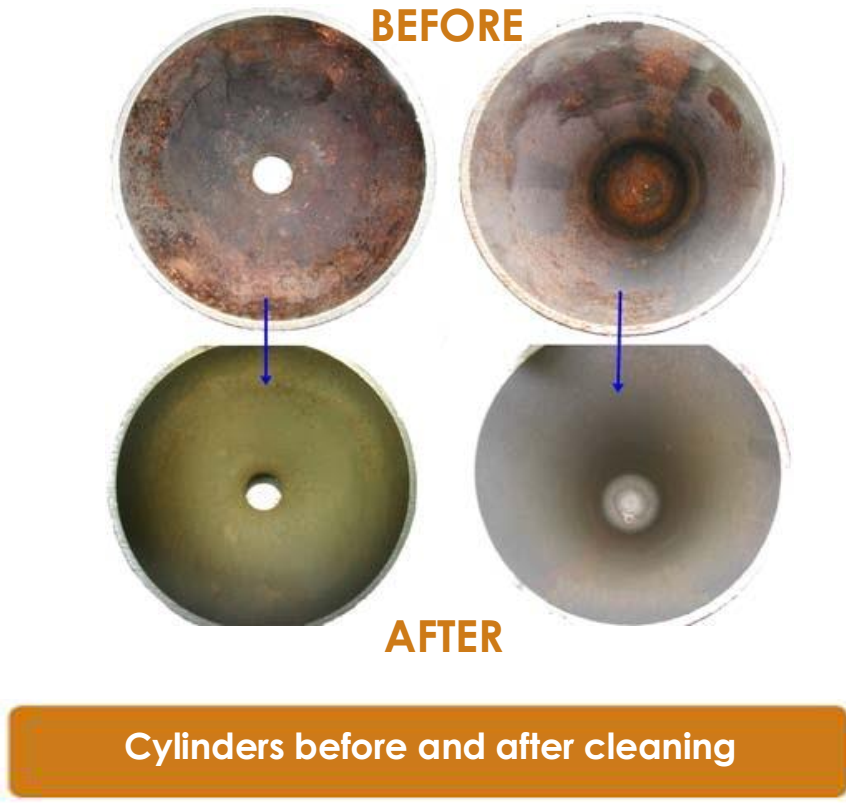
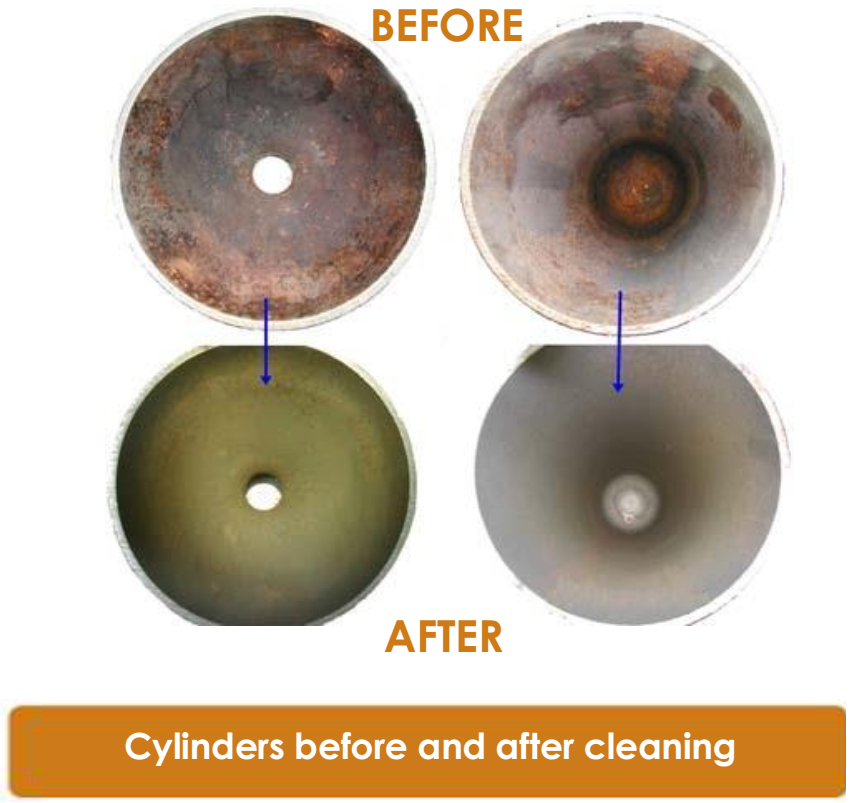
There are cases where, during official pressure testing, the inside of the gas cylinder cannot be inspected without adequate cleaning, and it cannot be determined whether its further use is safe or not.
If there is no cleaning, the bottle is scrap!
Diver
During scuba diving or when firefighters use respiratory protection, the gas comes into direct contact with our bodies.
Internal contamination can be harmful to health, or even lead to immediate emergencies.
No one should find themselves in a situation where their scuba tank valve becomes blocked underwater due to internal contamination!
I have a professional acquaintance who says they would only dive with a cylinder that they had serviced and cleaned themselves!
Major gas manufacturers, such as Linde, Messer, and SOL, mandate the internal cleaning of gas cylinders for certain applications.
This can include the food industry, for example, food-grade carbon dioxide or food-grade nitrogen, or even healthcare, such as medical oxygen or medical dinox.
Luxfer Gas Cylinders advertised their aluminium cylinders with a high degree of internal surface cleanliness, and had a successful campaign in England by doing so.
The beer won't taste rusty!
The internal surface cleanliness of gas cylinders is
High-purity gases and gas mixtures
is important during loading.
It makes a difference whether a specific gas, the value of which is many times that of a gas cylinder,
retains its stability for 6 months, or can be thrown away after 2 months.
In the cases listed above, the internal cleaning of gas cylinders can save customers significant costs.
The gas cylinder can remain in use.
The cylinder's use is healthy and safe.
Laboratories and calibration stations can be sure that they can continue to use the gas.
How and what pollutes the inside of a gas cylinder?
The main problem with steel gas cylinders is internal surface corrosion.
Moisture can get into the gas cylinder in a number of ways.
I have seen and maintained gas cylinders that had ice frozen inside them during winter.
There was one from which nothing froze because 1-2 litres of oil came out of it.
The main problem is improper storage and use.
I would mention just a few examples of these:
After the pressure test in case of improper drying.
The walls and bases of empty gas cylinders removed from the water pressure test bench can still contain 0.5-1 litre of water.
When it is cold at high humidity levels, even the moisture content of the air
can condense in the gas cylinder.
At low temperatures, moisture can enter an empty gas cylinder, even from
through a closed valve too.
Even the rolled-up Not even a plastic plug protects it the inside of the gas cylinder from water,
if it is stored outdoors without a valve.
If the valve not RPV designed.
RPV stands for Residual Pressure Valve.
The contents of the gas cylinder can be emptied completely.
In this case, a CO2 gas cylinder could even contain beer or cola.
Nitrogen cylinders could even contain oil from old, outdated filling machines or technologies.
Gas cylinder internal shot blasting
What solutions are there?
Mechanical tumbling with abrasive materials
The technology is already obsolete.
The essence of the method is to pour abrasive materials into the gas cylinders,
for example, rods or granules, and then begin to rotate or rock the cylinders for at least 1 hour,
preferably several hours.
Due to mechanical movement, gravity, and impacts, the inside of the cylinder is cleaned.
It is slow, cumbersome, and does not transfer sufficient energy.
According to Murphy's Law, the gas cylinder always gets cleaned where it shouldn't.
There is also a version of this system where we guide a chain through a rod into the cylinder,
and then start spinning the chain.
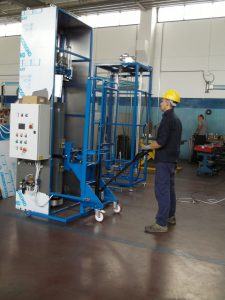
Sandblasting suit, spacesuitICS1850 gas cylinder internal cleaning machine with gas cylinder inverting and moving unit
Sandblasting
This was my first time working with this type of technology.
The advantage over the previous method is that it can already exert high energy.
It can also remove aggressive contaminants.
Its biggest disadvantage is the difficult handling of dust.
The worker usually has to work in a separate spraying booth with appropriate protection.
This is often a cumbersome spacesuit-like outfit.
Dust protection is difficult to manage.
Residual dust and sand can remain inside the gas cylinder, adhering to the wall.
They don't come out properly even when blown with a few bars of air.
Washing would damage the chemically clean metal surface.
Cleaning the gas cylinder is difficult.
Internal shot blasting of gas cylinders
To the barley grain, by virtue of its mass, it can transfer more energy compared to sandblasting.
The barley grain produces less dust.
The size of the dust is at a manageable level.
The bottles are usually placed upside down.
During the cycle, the shot empties from the gas cylinder.
The automation of shot blasting is simpler, easier.
Fewer tasks and burdens fall on the operator.
The nozzle located on the beer-soaking lance has multiple openings.
The openings are at different angles.
This allows for the cleaning of both the bottom and sides of the bottle, as well as the bottle's neck.
The multiple spray of the bead signifies a secondary cleaning,
which improves the cleaning of the bottom and neck areas.
Rust spots and other contaminants can be removed.
Its disadvantage, similar to sandblasting, is its sensitivity to moisture.
It is fundamentally suitable for removing dry contaminants.
The granules break down during use.
Ineffective, fragmented granules can be automatically filtered out.
Of the three solutions, the third solution is indeed the most expensive,
but the automation, lower labour costs, and high quality
will repay the initial investment in a short period.
I clearly recommend the third solution for the internal cleaning of gas cylinders.