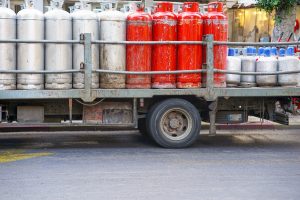




What will we cover regarding the typical main sizes of gas cylinders?
We will list all typical main sizes, such as general length and diameter. We will provide the main differences between various manufacturing runs. Here we will primarily focus only on physical dimensions.
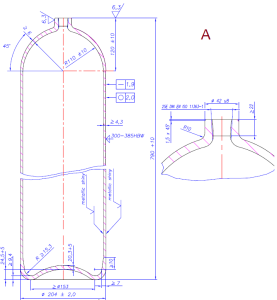
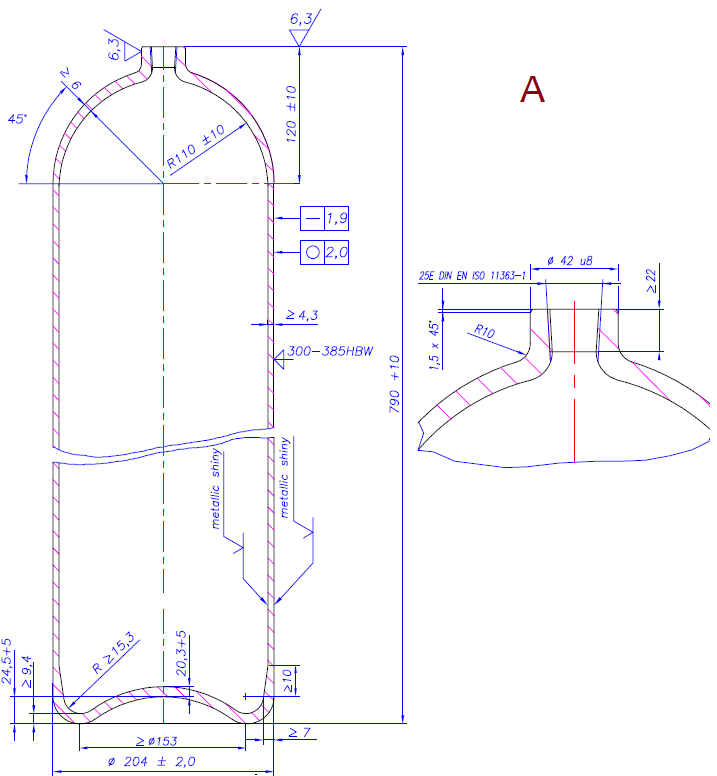
Please look at the gas cylinder drawing below.
You will certainly find the following data on every drawing:
- Length
- diameter
- Wall thickness
- weight
We'll show some examples of the sizes.
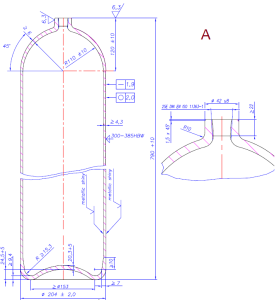
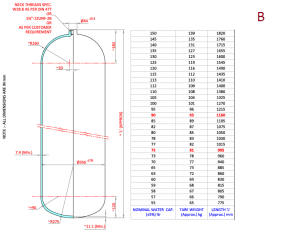
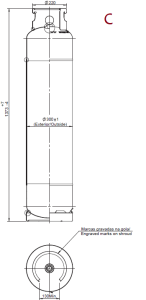
Typical gas cylinder main dimensions – low-pressure gas cylinder. You can see the typical dimensions: length, diameter, weight.
The typical main sizes for gas cylinders are 10kg, 11kg, 13kg, and 30kg.
- Capacity (litres, ltr): This signifies the minimum internal size into which we can fill a given number of litres of water. „Minimum” is very important. Manufacturers can deviate upwards in terms of capacity at most due to manufacturing tolerances, because a larger capacity means lower pressure and less risk for the same amount of gas. You can make a mistake or deviate in favour of safety. So this is the minimum guaranteed capacity.
- Diameter (d, D, Ø) This refers to the nominal total external diameter of the gas cylinder, specified in millimetres. There will always be a specified tolerance here. The manufacturer may specify this tolerance in millimetres or as a percentage. For example: ±1% or ±2.5 mm. The tolerance arises from inaccuracies in the drawing of the tube or in the tube itself. It must always be taken into account where millimetres matter, such as in the manufacture of metal pallets for transporting gas cylinders. There are key diameter ranges, such as 102 mm, 117 mm, 140 mm, 152 mm, 204 mm and 229 mm. These diameters are primarily derived from the military industry. If necessary, production capacity for gas cylinders can be quickly converted to the manufacture of military equipment.
- Length (L, l): This is the total length of the gas cylinder without any other attachments. It is mostly given in millimetres. Often, the exact size is not shown on the drawing of the gas cylinders; the drawing will only have an „L” or „l” marking, or the body of the cylinder is depicted as broken, as shown in drawing „A” or „B”. The break in drawing „A” rather indicates that the drawing is not to scale. So that the details of the neck and base can be seen, the cylinder body has not been drawn in its entirety. In drawing „B”, however, the break also indicates that several lengths occur within that specific gas cylinder family. The typical main dimensions of the gas cylinder belonging to the cylinder family can be found in the table next to the drawing.
- Wall thickness (mm): The wall thickness is given in millimetres. The given value must be guaranteed by the manufacturers, as it is the minimum wall thickness at which the specified pressure can be safely stored during design. Better manufacturers will have a smaller deviation above the specified minimum, whereas bottle manufacturers with less experience or poorer technology will have much greater deviations above the bottle wall thickness. This will be most evident in the total weight.
You can also find out all other information from our summary article about the gas cylinder.
How should the typical main sizes of gas cylinders be interpreted within a family/range?
Gas cylinder family – What is a gas cylinder family? Gas cylinder manufacturers have the option to approve multiple cylinder types at once. Naturally, this represents a lower cost for them and a simpler process.
What can a single family include? The smallest member of the family cannot be shorter than three times the diameter of the gas cylinder. The largest member cannot be larger than one and a half times the length of the gas cylinder submitted for examination. Members of the gas cylinder family are made with the same diameter. Another variation can be that several thread types can be specified within the cylinder family. Wikipedia.
Variations among gas cylinder manufacturers: These are the most common main dimensions. The given dimensions can vary from manufacturer to manufacturer. Why do the length and weight of gas cylinders vary? A high-end manufacturer with high technology allows for a smaller variance in the wall thickness of gas cylinders. Smaller variance also equals a smaller average wall thickness. This means a lower weight. For example, you might find a 50-litre, 200 bar gas cylinder weighing 42 kilograms, but another manufacturer might produce it at 53 kilograms. You can consider which gas cylinder the operator would prefer. Naturally, the lighter one.
Variety by raw material: The wall thickness of steel cylinders will be less than that of aluminium cylinders at the same operating pressure. Steel is much more resistant at the same thickness than aluminium. For example, the wall thickness of a 50-litre steel gas cylinder with an operating pressure of 200 bar will be between 4.7 mm and 5.4 mm. With the same parameters, an aluminium cylinder, for example made of AA6061 material, will have a wall thickness of 15-16 mm.
As a general rule, we can say:
- Higher pressure means a greater wall thickness.
- A greater wall thickness means a greater weight.
- The wall thicknesses of hydrogen cylinders or cylinders for aggressive gases will be greater.
- If the bottles have the same outer diameter and the same volume, but one will have a greater wall thickness, then its length will also be greater.
General rules for typical main sizes of gas cylinders
This data has been compiled based on gas cylinders from various manufacturers. Of course, if you wish to find a gas cylinder with a different diameter or length, you will certainly be able to find one from certain manufacturers. Here, we are only showing the most typical sizes. Over many decades, manufacturers have created hundreds of gas cylinder types for various projects.
Deviations in the typical main dimensions of gas cylinders, even within the same batch number
If you have limited, very confined space where you intend to install the gas cylinder, you must always account for the fact that variations can occur even within the same production batch. For example, if we are talking about a 200 bar, 50-litre gas cylinder, you may find weight differences of ±1-2 kg and length differences of ±5-9 mm within a batch of 200.
200 bar high-pressure gas cylinder typical main dimensions
Volume litre, diameter mm, length mm, weight kg
| Volume | Typical size data |
|---|---|
| 1 litre | 83 mm, 260–275 mm, 1.5–1.6 kg |
| 2 litres | 100/102 mm, 345-355 mm, 2.3-2.7 kg |
| 2.7 litres | 460 mm, 3.6 kg |
| 3 litre | 114–115 mm, 400 mm, 3.5 kg |
| 5 litres | 140 mm, 435-450 mm, 5.5-5.9 kg |
| 8 litres | 140 mm, 480 mm, 11 kg |
| 8 litres | 178 mm, 450 mm, 11.2 kg |
| 10 litres | 140 mm, 795-850 mm, 9.7-16.4 kg |
| 10 litres | 152 mm |
| 12 litres | Primarily for diving use |
| 13.4 litres | 178 mm, 700 mm, 15 kg |
| 15 litres | 140 mm, 1230 mm, 23 kg |
| 15 litres | 204 mm, 615-620 mm, 19 kg |
| 20 litres | 204 mm, 780-790 mm, 21-24 kg |
| 30 litres | 204 mm, 1095 mm, 25 kg |
| 30 litres | 229 mm, 920-1115 mm, 30-41 kg |
| 40 litres | 204 mm, 1450-1480 mm, 39-42 kg |
| 40 litres | 229 mm, 1170-1215 mm, 37.5-49 kg |
| 50 litres | 229 mm, 1405-1500 mm, 41-60 kg |
| 60 litres | This was not in the original text. |
| 67.5 litres | 267 mm, 1410 mm, 54 kg |
| 70 litres | 267 mm, 1500 mm, 73 kg |
| 80 litres | 267 mm, 1700–1745 mm, 82–90 kg |
| 100 litres | 267 mm |
| 100 litres | 360 mm, 1290 mm, 129 kg |
| 110 litres | This was not in the original text. |
| 120 litres | 360 mm, 1510 mm, 147 kg |
| 130 litres | This was not in the original text. |
| 140 litres | 360 mm, 1730 mm, 165 kg |
| 150 litres | 360 mm, 1840 mm, 174 kg |
| 160 litres | This was not in the original text. |
| 180 litres | 360 mm, 2150 mm, 199 kg |
| 190 litres | 360 mm, 2255 mm, 210 kg |
| 200 litres | This was not in the original text. |
300 bar high-pressure gas cylinder typical main dimensions
In the old WPBakery content, this section only had the title; detailed size data was not provided.
Gas cylinder typical main sizes – ancillary equipment
When you're calculating the necessary dimensions for the space required for your gas cylinder, remember to include accessories for the gas cylinders. This can be important, for instance, when you want to place a carbon dioxide cylinder into a water dispenser machine. Or, for example, when you want to stand your gas cylinder up inside your service vehicle.
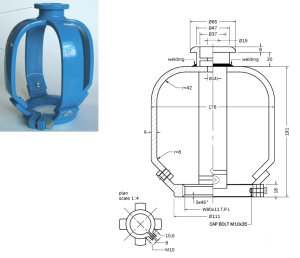
As you can see in the drawings above, if the accessory is welded to the gas cylinder – for example, the welded valve protection flange on the low-pressure gas cylinder – then the main cylinder length already includes the length of the accessory.
In addition to this, you need to bear in mind the other spare parts:
- Gas cylinder valve The typical length of a valve is between 100-110 mm. From this length, a part is screwed into the cylinder. Therefore, a valve increases the length of the cylinder by approximately 90-100 millimetres.
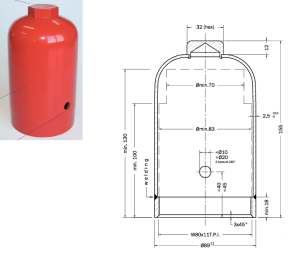
- Gas cylinder valve protection cap The typical height of a gas cylinder valve protection cap is 120-140 mm. Naturally, the size of the cap only matters during transport, not when in use or being filled. The cap's diameter is close to 80 mm. The standard neck ring thread is W80, which is a thread with a diameter of 80 mm. So, the cap has a diameter of 83-100 mm.
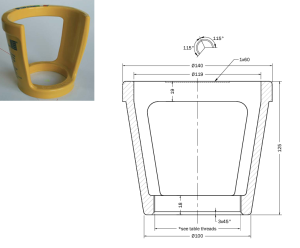
- Gas cylinder valve protection flange The flange will always be on the bottle. Gas bottle typical main sizes will include this for calculation, shipping, use and filling. The flange height will be similar to the cap height, around 120-140 mm. Some very resistant, robust steel valve guards will exceed this, reaching up to 190-200 mm in height. Unlike the gas bottle cap, the upper part of the flange will be wider, potentially reaching 140-150 mm in width. The most robust valve guards can also have a diameter of 190-200 mm.
Typical dimensions of gas cylinder accessories