



All things gas cylinder
A knowledge base covering every aspect of gas cylinders. Cylinder types, accessories, valves, approvals, manufacturing, dimensions, and weights all in one place. We hope you find what you're looking for.
What is a gas cylinder? (definition)
In the technical field, when we want to define something precisely, we always go back to the basics – to gas industry standards. The most fundamental standard would be ISO 10286 Gas cylinders – Vocabulary. This standard contains everything related to gas cylinders, but unfortunately, it does not define what the concept of „gas cylinder” actually is.
Generally, when we talk about a gas cylinder, we are referring to a container used for storing gas, with a volume between 0.5 litres and 150 litres. The purpose is to store gases above atmospheric pressure. There are limitations to this definition: if the container is smaller than 0.5 litres, we usually refer to it as a cartridge. If it is larger than 150 litres, it can be called a tank, a bundle, or a Multi-Element Gas Container (MEGC), or a Jumbo cylinder.
The gas cylinder is a useless product in itself. Everyone only wants to use the gas inside it, not the gas cylinder. The gas cylinder is just packaging. One of my teachers from long ago.
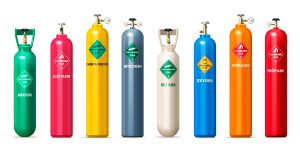
Gas cylinder types
We can group gas cylinders according to several aspects. Grouping according to different criteria may often seem like an end in itself, but many groups are widely accepted in the industry. Manufacturing technology, from seamless pipe or tube, welded or seamless, aluminium or steel. Below we have collected the most important groups. Different segments require different types of gas cylinders.
Gas cylinder type groups
ACÉL gas cylinders
The most common and cheapest gas storage solution. This is why you will most often find the material designation 34CrMo4 chromium-molybdenum on steel gas cylinder designs. Low cost for the raw material and high energy cost for production.
ALUMINIUM gas cylinder
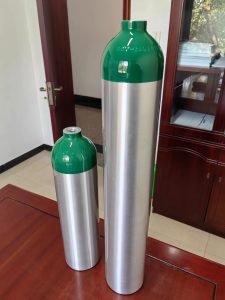
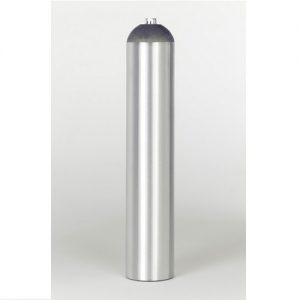
A clean solution without corrosion. Ideal for the food industry or healthcare. Aluminium is magnetically neutral, meaning you can use it in environments like MRI scans. Well-known aluminium alloys used for cylinder manufacturing include AA6061, AA7032, AA7060, and AA2001. Expensive high-purity gases or gas mixtures will retain their quality better in aluminium cylinders compared to steel gas cylinders. Advanced new aluminium cylinders also outperform steel ones in terms of weight.
Stainless steel bottle
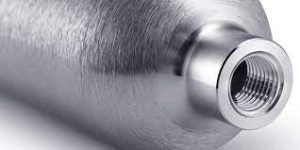
It's a rather expensive solution for storing gases. Their use and manufacture are very rare. The use of stainless steel cylinders might be considered if the gas is very aggressive or if the gas is worth millions.
Plastic gas cylinders
Within the pressure range we are primarily discussing, plastic gas cylinders are not really an option. At such high pressures, plastic cylinders mainly appear as liners for composite cylinders – see later.
Composite gas cylinder
Liner
The composite gas cylinder is made from a combination of several base materials. Generally, there is a base form (liner) which gives the gas cylinder its stable shape, onto which the pressure-bearing elements can be attached/wound. The liner itself could withstand approximately 60 bar of pressure, but together with various wound materials, this value increases to over 200 bar, 300 bar, or even 500 bar.
Structure
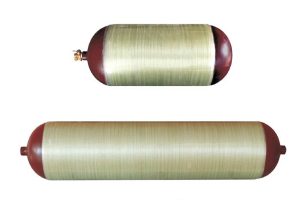
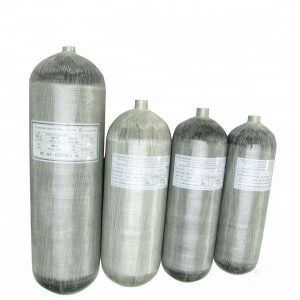
In the most common 3-component composite cylinder, the pressurised carbon winding is placed onto the liner – a resin bed. A glass fibre winding, which protects the carbon fibres, is applied over this. For example, on a breathing apparatus cylinder, the grey/black winding is the carbon fibre, while the light/white fibres visible above it are the glass fibre protecting the carbon fibre. Many types of liner materials exist (steel, aluminium, plastic, carbon). There are also several common types of pressurised winding, such as carbon fibre and glass fibre. Based on the location of the winding, we distinguish between a hoop-wound composite cylinder or a fully overwound composite cylinder.
Pressure ranges
- Low-pressure gas cylinder – the maximum pressure of the low-pressure gas cylinder is 35 bar (500 psi)
- High-pressure gas cylinder – anything above 35 bar is considered a high-pressure gas cylinder
Operating pressure and test pressure are mandatory data that must be included in the neck markings of gas cylinders. If a pressure other than the operating pressure is required by the end-user, then a pressure reducing valve can be used.
The basic shapes from which a gas cylinder can be manufactured:
According to the initial form of the raw materials
- Tin plate – typically, the sheet metal is deep-drawn here into the desired shape. The formed two or three parts are assembled by welding into a gas cylinder.
- Bugaba – from a solid metal block – which is usually a solid cylinder and is called a „billet” – it becomes formable after heating. After heating, the bottle body is formed from it. Here, the body of the bottle – its shell – and the shape of the base are formed in one piece. The neck is formed in a separate step, which is usually formed by hot spinning. Further information and materials can be found in the engineering gallery: Hot Piercing or Seamless Tubing | Engineers Gallery
- From the tube – when the pipe with the appropriate pressure resistance is cut to the desired length, and the neck and base are formed by the previously mentioned rotary forging.
Deliverability
- Deliverable – most gas cylinders transported under pressure within the European Union are approved according to TPED (Transportable Pressure Equipment Directive 2010/35/EU). The most common use of gas cylinders is: the gas cylinder is filled at the gas factory and then transported to the place of use. There, the gas is consumed and the cylinder is returned to the filling site.
- Fixed – there are approval procedures where transport is not the main element. The loading caused by dynamic pressure changes on the gas cylinders is a much greater concern. This approval procedure is the PED (Pressure Equipment Directive 97/23/EC and 2014/68/EU). A typical use case for these gas cylinders is a compressor station's buffer tank or a vehicle CNG filling station.
Gas cylinder types
- Type 1 (T1) – all-metal gas cylinder
- Type 2 (T2) – Metal liner + wrapped casing design
- Type 3 (T3) – Metal lined + full surface wound design
- Type 4 (T4) - plastic lining + full surface wound
- Type 5 (T5) – carbon fibre bottle only (both liner and wrappings made of carbon fibre)
Gas cylinder refilling frequency
- Rechargeable – this type of gas cylinder is refilled many times during its lifetime. These cylinders can be refilled again and again. Therefore, the cylinder can usually be refilled without any problems in daily or weekly cycles. The prescribed maintenance must be carried out at certain intervals.
- Disposable (single-use) – the bottles are designed for single filling and use. Good examples of such bottles are soda or cream chargers. These are filled with CO2 (carbon dioxide) and N2O (dinitrogen oxide).
Filling
- For permanent gases – the most common fillings are oxygen, nitrogen, argon, and helium, which are classified as permanent gases. Here, the filling remains in gaseous form even under pressure at the cylinder's operating temperature. During the entire filling and usage cycle, gaseous material is filled, stored, and used. When selecting cylinder material, attention must be paid to the compatibility of the gas with the cylinder material (ISO 11114).
- Liquefiable gases – The gas cylinder is manufactured for gases where a portion or all of the filling becomes liquefied under normal conditions of filling and use. Such gases include carbon dioxide (CO2), sulphur dioxide (SO2), and propane-butane LPG gas cylinders. From the perspective of gas cylinders, there is no operating pressure here, only test pressure. For example, the most common test pressure used for carbon dioxide is 190 bar or 250 bar.
- Dissolved gases – there are gases – most commonly acetylene or a dissolved gas cylinder C2H2 – which would be very dangerous to transport under the same conditions as, for example, permanent or liquefied gases. This is because the gas would be so unstable in these forms that its transport would be dangerous. Therefore, acetylene is absorbed into another substance (acetone), which, together with the mass already filled into the gas cylinder, makes transport safe.
Gas cylinder types
Gas cylinder manufacturing
Methods for the manufacture of gas cylinders
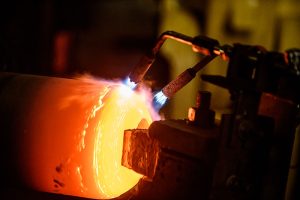
There are 3 main manufacturing processes for gas cylinders (we are only discussing the manufacturing processes for purely metal cylinders here). The simplest manufacturing process is to form the neck and bottom parts separately. This is generally done by a high-strength press from sheet material. The parts are then welded together as follows:
- If you only weld the top and bottom parts together, you'll get a two-part bottle.
- If a middle body (also known as a casing) is incorporated between the bottle neck and the bottle base, then we are talking about a three-part gas cylinder. The cylinder body can be made from tubing by cutting it to size, or it can also be made from sheet metal by rolling and welding.
The other major group of manufacturing is when we produce gas cylinders without any welding. That is to say VARNISH We are making a bottle. The raw material can arrive here in two forms:
- We manufacture the gas cylinder from tube, where the neck and bottom are formed by forging.
- The manufacturing is done by stretch forming, including the bottle base, and then the neck forming is completed by forging.
Gas cylinder manufacturing standards
We have outlined the manufacturing procedures in broad strokes. Design and the authorisation procedure are another matter. There are many types of gas cylinders associated with the gas industry. Different standards prescribe the manufacturing procedures for steel cylinders, and different standards detail the manufacturing system for aluminium cylinders. Low pressure versus high pressure is also a different kettle of fish. The most common standards are as follows:
Most common gas cylinder design and manufacturing standards
- EN I1964-3: Transportable steel gas cylinders of seamless, refillable construction, with a capacity of at least 0.5 l and at most 150 l, specification for design and construction
- ISO 9809-1: Gas cylinders - Refillable seamless steel gas cylinders - Design, construction and testing - Part 1: Steel cylinders for permanent gases with a tensile strength less than 1 100 MPa
- ISO 9809-2: Gas cylinders – refillable seamless steel gas cylinders – Design, construction and testing – Part 2: Steel cylinders with a tensile strength greater than or equal to 1 100 MPa
- ISO 9809-3: Gas cylinders – Refillable seamless steel gas cylinders – Design, construction and testing – Part 3: normalised steel cylinders
- EN ISO 11120 – Gas cylinders. Refillable seamless steel gas cylinders of 150 L to 3000 L capacity. Design, construction and testing (ISO 11120:2015)
- EN 1975 – Design and construction of refillable, transportable, seamless aluminium and aluminium alloy gas cylinders of capacity not less than 0.5 l and not more than 150 l
- EN 84/526/EEC – Design of aluminium alloy gas cylinders for compressed gas
- EN 12245 – Transportable gas cylinders. Fully wrapped composite cylinders
- ISO 11119-1 Gas cylinders — Design, construction and testing of refillable composite gas cylinders — Part 1: Construction and testing of fully-wrapped fibre-reinforced composite cylinders and tubes up to and including 450 litres
Manufacturer markings on gas cylinders
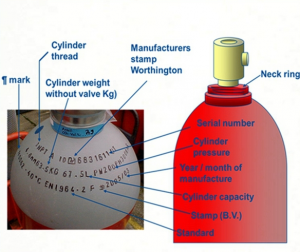
We are working in a high-pressure hazardous area. Therefore, identification is vital. In all cases, we must be able to trace every gas cylinder back to its manufacturer. The Bottle labels it is natural to identify the manufacturer. We definitely need 3 main signals (this is the basis of identification):
- Gas cylinder manufacturer's identification stamp
- Date of manufacture
- Gas cylinder serial number
Gas cylinder authorisation procedure

In addition to physical manufacturing, there are a number of licensing and documentation requirements for the production of gas cylinders. In Europe, the most common licensing procedures are:
- TPED (Transportable Pressure Equipment Directive) – gas cylinders that can be transported under pressure
- PED (Pressure Equipment Directive - Nyomástartó eszközök direktíva) – mainly for in-situ pressure systems. However, this category also includes SCBA (self-contained breathing apparatus cylinders), or the carbon dioxide (CO2) cylinders of fire extinguishers, or diving cylinders.
- ECER110 – gas cylinders for use as motor vehicle fuel during propellant consumption.
In America, the main standards are those of the DOT (Department of Transportation). These standards govern the design, manufacture, and certification procedures in the field of pressure vessels.
Gas cylinder identification
The safety markings on gas cylinders contain different elements. All colour markings, sticker imprints form a complete system. There you can see marks that are not easily removable, deeply stamped into the neck of the gas cylinder. There are also marks that are clearly recognisable even from a distance. This could be, for example, the tell-tale colour of the gas cylinder. The system also includes a sticker attached to the cylinder, which provides information about the last refill.
- Stamped/imprinted gas cylinder markings The stamped or engraved markings on the neck and base of the gas cylinder are permanent throughout the cylinder's life, ensuring traceability and retrievability. Normally, these markings do not change during the cylinder's lifespan. Manufacturer, date of manufacture, country of manufacture, serial number, manufacturing and certification standards. Type of gas, if indicated. The weight of the gas cylinder... all information strictly related to the structure of the gas cylinder.
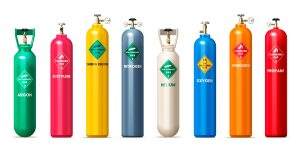
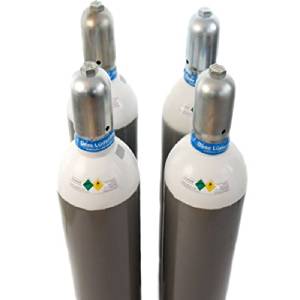
- Colour designations good recognisability when determining the contents of the gas cylinder from a distance. As a general rule, the body colour indicates the main area of use (but not compulsory) white = healthcare, green = special gas, yellow = food industry, grey = industrial use. The neck colour provides mandatory information about the type of gas (red-flammable, yellow-toxic...)
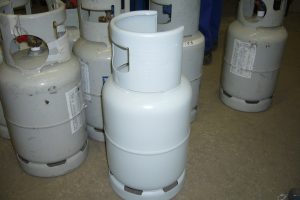
- Stickers – it provides information and traceability to the last filling station and gas manufacturer. It also provides the mandatory data according to ADR.
Parts of gas cylinders
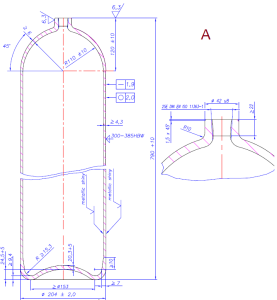
The main parts of gas cylinders are the base/bottom, neck, and shell or body. Some accessories can be permanently attached to the gas cylinder. These can include a neck ring or a welded valve guard flange. We will create a full description of gas cylinder accessories, which will also include photographs and full type descriptions. Examples of these include convex or concave cylinder bases.
Gas cylinder sizes
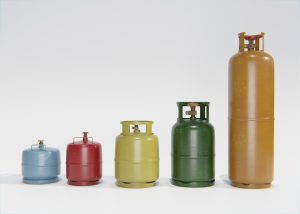
What are the most important standard sizes for gas cylinders? How are gas cylinder sizes denoted? 2 kg, 5 kg, and 10 kg CO2 gas cylinders are common sizes from gas manufacturers. You can fit short 10 kg CO2 gas cylinders under the counter if you're a bar owner. You regularly transport 50-litre oxygen and acetylene cylinders if you do welding work in the field. As a firefighter, you might have been deployed with a 6.8-litre breathing apparatus gas cylinder on your back. Healthcare professionals might have used 2, 5, 10-litre or 20-litre oxygen cylinders in ambulances in hospital. We have collected the most important precise measurements, including weight, length, and diameter. We will explain why we specify bottle sizes in litres, cubic meters (m3), or kilograms (kg).
There are situations when you need to know the exact size of a gas cylinder. You may have limited space for storing or using the gas cylinder. This could be a water dispenser machine into which you want to insert a carbon dioxide gas cylinder. Perhaps you want to transport a 10-litre oxygen cylinder in an ambulance. Length, diameter with and without accessories. What is the approximate length of a gas cylinder?
- Gas cylinder sizes? – List and brief explanation of the main units of measurement (litre, kg, m³)
- Gas cylinder parameters – main parameters of gas cylinders (length, diameter, dimensions including accessories...)
Accessory equipment for gas cylinders
When using gas cylinders, we will also encounter numerous gas cylinder accessories. Just consider the valve, that's enough. Without a valve, it would be difficult for us to keep any gas in the cylinder.
- Gas cylinder valve
- Pressure reducer
- Valve cap
- Valve guard flange
- Gas cylinder protective net
- Gas cylinder carrying metal pallet
In addition to a few examples, we provide a full list of accessories for gas cylinders.
Storage and transport of gas cylinders
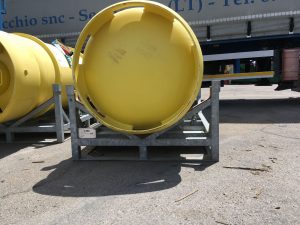
In Europe, the ADR („European Agreement concerning the International Carriage of Dangerous Goods by Road“) regulates safe storage and transport.
Lifespan of a gas cylinder and its disposal
In general, standard gas cylinders do not have a lifespan limit. It can be said that as long as they pass periodic inspections, they can remain in operation. This rule may vary from country to country, or it may differ in different design and manufacturing standards. For example, there was a time in Hungary when the maximum lifespan of cylinders manufactured by the old „Csepel Pipe Factory” was 50 years. This was later changed.
When composite cylinders started to become widespread globally, based on cyclical pressure tests, the first gas cylinders were given a maximum lifespan of 15 years. As the years passed, it was no longer possible to keep the gas cylinders in service. Even if the gas cylinder had spent its years sitting on a fire brigade's shelves, unused, it still had to be disposed of. It had to be scrapped even then!
Later, more advanced composite bottle types were given a lifespan of 20 years, then 30 years. Then composite bottles with unlimited lifespans appeared.
When a gas cylinder has expired or has not passed its periodic inspections or pressure tests, it must be decommissioned. During decommissioning, the gas cylinder must be modified in such a way that future refilling and use are impossible. Furthermore, it must also be made impossible to repair. The neck or body must be destroyed by cutting, damaging, or puncturing.
Maintenance of gas cylinders
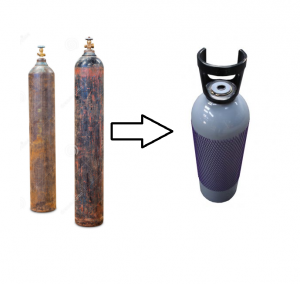
Most commonly, international regulations require inspection every 10 years for a standard gas cylinder. The period is shortened for very aggressive or corrosive gases, where more frequent inspection is necessary. Examples include chlorine or sulfur dioxide. The ADR precisely defines the required inspection period.
There are specific areas that have their own defined cycles. The best known of these areas are:
- Fire extinguisher cylinders
- Vehicle fuel canisters
- Diving or SCUBA tanks
- Local rules may differ from country to country
The gas cylinder maintenance process contains several steps. Depressurisation and rendering harmless of gas cylinders, identification, external and internal inspection. The critical part is the weight measurement and pressure testing, which we carry out at one and a half times the operating pressure. For the full description, check the previous link.
Delivery of gas cylinders
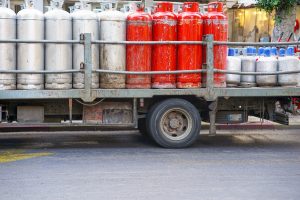
During storage and transport, gas cylinders must be secured against tipping over. This could be a securing chain that fixes the cylinder to the wall. Or during transport, a metal gas cylinder cage to which the cylinders have been properly secured with webbing straps. They can be handled appropriately with a forklift or crane. The ADR contains all the regulations for the handling of gas cylinders.
Valve protection must always be maintained during transport. This can prevent a more serious problem – valve breakage – in the event of an overturn.